
Location, Location… Maybe Later
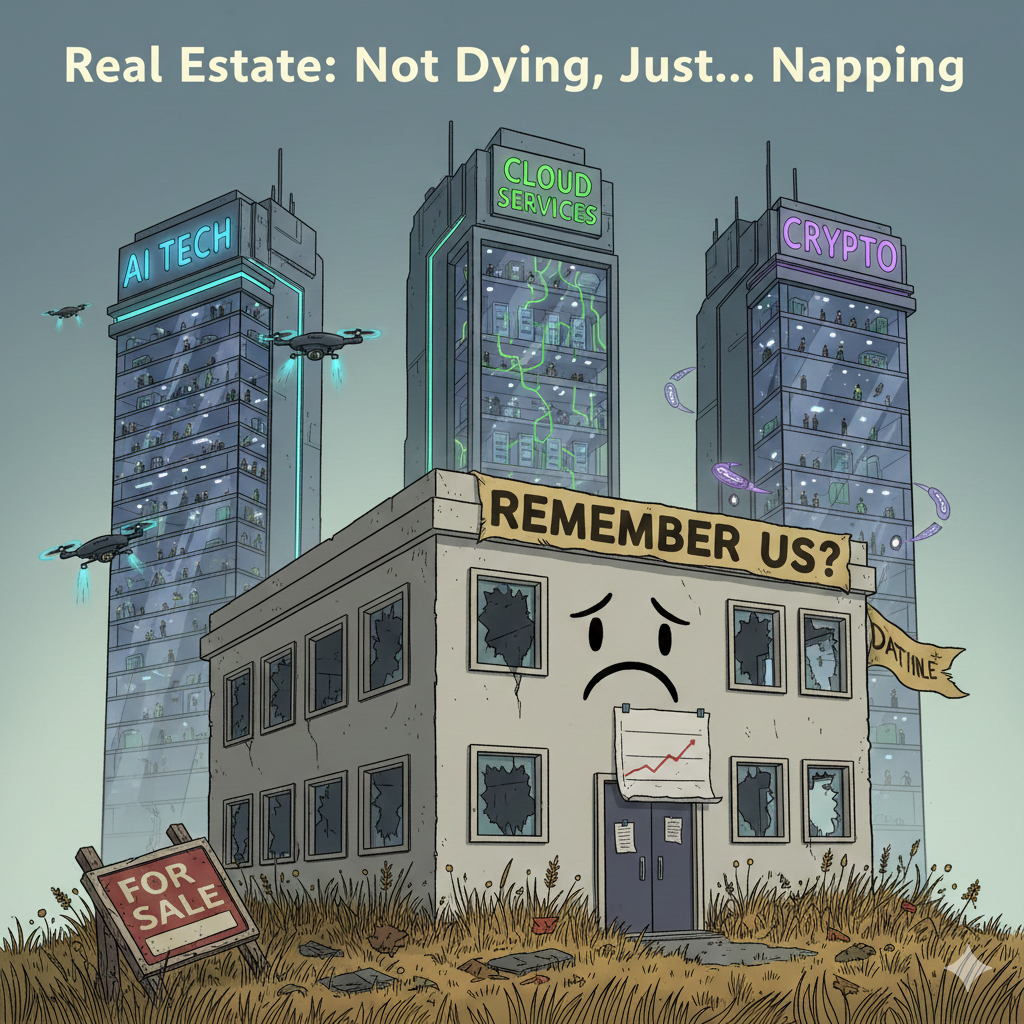
Let’s talk about the hottest new trend in investing: ignoring real estate.
Yes, that sacred pillar of the American Dream—property ownership—is currently sitting alone at the high school dance while Communication Services makes out with AI stocks in the parking lot. The S&P 500 has been up 17% over the past year. Real estate? A smoldering 3%. That’s not “trailing the market.” That’s showing up to the Olympics in Crocs.
If sectors were party guests, real estate is the guy who brought a Jell-O mold to a tapas-themed dinner. It’s not just out of style—it’s actively confusing people.
But here’s the twist: while everyone’s busy ghosting real estate, a few chart-watchers are slipping it a text. “You up?”
The Apartment You Can’t Afford and the Office No One Wants
Let’s begin with a quick tour of the current real estate dystopia. Residential? Frozen. Commercial? Ghost town. This is a market so paralyzed that sellers won’t sell, buyers can’t buy, and landlords are just glad their tenants aren’t starting mushroom farms in the drywall.
Mortgage payments are now 63% higher than they were in 2021, which means most homeowners are clinging to their 3% mortgage like it’s a golden ticket. Selling your home now would be like selling your favorite pair of jeans because pants in general have gotten more expensive.
Meanwhile, the commercial side looks like a reverse Gold Rush: instead of everyone rushing west for opportunity, we’re collectively sprinting away from downtown office space like it’s a haunted house that also charges $40 a day for parking.
In other words, the real estate sector is currently performing like a Band-Aid on a submarine. And yet… that’s not the end of the story.
Not Hot. Just… Less Cold?
Enter JC O’Hara, a chart-whisperer from Roth Capital Partners. He’s not telling us to fall in love with real estate. He’s not even recommending a first date. He’s saying, essentially, “Look, the patient’s not coding anymore. Maybe peek into the room occasionally.”
This is what we call “tactical optimism”—which is like regular optimism, but with a helmet and safety net.
O’Hara points out that, technically speaking, the sector isn’t bleeding out anymore. It’s not strong, but it’s not weak. Picture someone at the gym who’s not lifting weights yet, but did finally cancel their Arby’s app subscription.
And because real estate makes up just 1.85% of the S&P 500, being “overweight” in it isn’t a bold move—it’s more like ordering a side salad when everyone else is doing shots of Nvidia.
Real Estate’s Problem Isn’t Just Rates. It’s Relevance.
Let’s pause to zoom out. It’s tempting to blame high mortgage rates and remote work for everything. But real estate’s woes go deeper. They’re existential.
We built a financial and cultural empire on the idea that location is everything. But what happens when the most valuable place to work, shop, and socialize… is your couch?
Office towers were built on the assumption that people had to physically gather to generate value. Now we know that value can be generated just fine over Slack and Zoom—while wearing pajama pants and passive-aggressively muting each other.
And homes? The dream of buying one is still alive, sure, but mostly because the alternative is renting from a landlord named “Westwood Horizon Homes LLC” who charges $3,200/month for a converted broom closet with “modern rustic vibes.”
The Aha Moment (With a Side of Shrug)
O’Hara’s thesis isn’t that real estate is back. It’s that it might be worth watching again. Like a reboot of a beloved show you thought was cancelled forever. “Real Estate: The Reckoning” might not win awards, but it could sneak its way back onto your watchlist.
Some REITs—like Welltower and Prologis—are showing early signs of life. Others, like Simon Property Group, might get a post-earnings glow-up. But this isn’t a call to arms. It’s more like a call to… slightly adjust your portfolio settings.
And that’s what makes it interesting.
Because in a world obsessed with betting on what’s next—AI, semiconductors, meme stocks named after moon animals—real estate is daring to ask: “What if the boring thing isn’t dead, just dormant?”
Investing in the Land of the Left Behind
There’s something quietly subversive about tilting your portfolio toward a sector everyone else has given up on. It’s like choosing to listen to an album after the band stops trending on TikTok.
And maybe that’s the real point here: not that real estate is the next big thing, but that our obsession with only chasing the big thing blinds us to quiet recoveries.
Sometimes investing isn’t about finding the next rocket ship. Sometimes it’s about noticing when a sector stops actively sinking.
O’Hara’s not offering salvation. He’s offering a shrug and a chart that says, “Hey, the line’s not going down anymore.” And in today’s market, where attention spans are shorter than your mortgage application denial email, that might be enough.
Final Thought: A Sector Without a Punchline
If real estate were a stand-up comic, it wouldn’t be getting booked right now. Not because its material is bad—but because everyone’s too busy laughing at AI’s tight five on human obsolescence.
But maybe—just maybe—while the crowd is distracted, real estate is quietly workshopping its new set. Less flashy. More thoughtful. Fewer punchlines, but better timing.
And when it finally returns to the stage, you might be glad you kept your seat.